

Here’s what you’re learn in this blog post:
- The Core Concept: The Eisenhower Matrix is a decision-making framework that categorizes every task into four quadrants based on its level of urgency and importance.
- The Strategic Value: It allows high-performers to stop reacting to low-value noise and start investing in the high-impact activities that generate long-term “Alpha.”
- The Friction Killer: The matrix identifies “sideways energy” by highlighting the specific tasks that should be delegated or deleted entirely to protect your mental bandwidth.
- The Performance Shift: It acts as a biological filter for your attention, moving you from cortisol-soaked firefighting to calm, strategic execution.
- The Bottom Line: By using the matrix, you ensure that the immediate, loud demands of others never override the quiet, strategic priorities of your own legacy.
How often do you use the following phrases?
- I’m slammed
- In the weeds
- Snowed under
- Flat out
- Drinking from a firehose
- Underwater
- Up to my eyeballs
If you’re using any of those phrases, keep reading. You need to hear this.
You’re probably treating your time like a cheap Monopoly money — you’ll keep spending until you’re ultimately out of cash.
That’s called being time/energy bankrupt.
The truth is, we all want to squeeze more into the day, but “hustle culture” is a linear lie in a non-linear world.
At a certain point, you hit a biological ceiling — you just can’t squeeze more into the day.
In my new book, Better: A Guidebook to a New and Improved You, I write about a system, developed by Dwight Eisenhower, that gives you an edge in your career and your life.
It’s called the Eisenhower Matrix and it’s named after the man who liberated Europe, not a guy who spent his afternoon optimizing his Slack notifications.
The Eisenhower Matrix
The math is simple: you have four buckets for every task on your plate. Each bucket of tasks has two of these four characteristics:
- Urgent,
- Important,
- Not Urgent,
- Not Important
If you focus on the “Important, Not Urgent” section (Quadrant II), you’ll end up a winner.
The problem is, most of us spend our time in Quadrants I, III, and IV.
Check out the four quadrants below.
And remember, if you don’t move your focus to Quadrant II, you’re just a passenger in your own career.
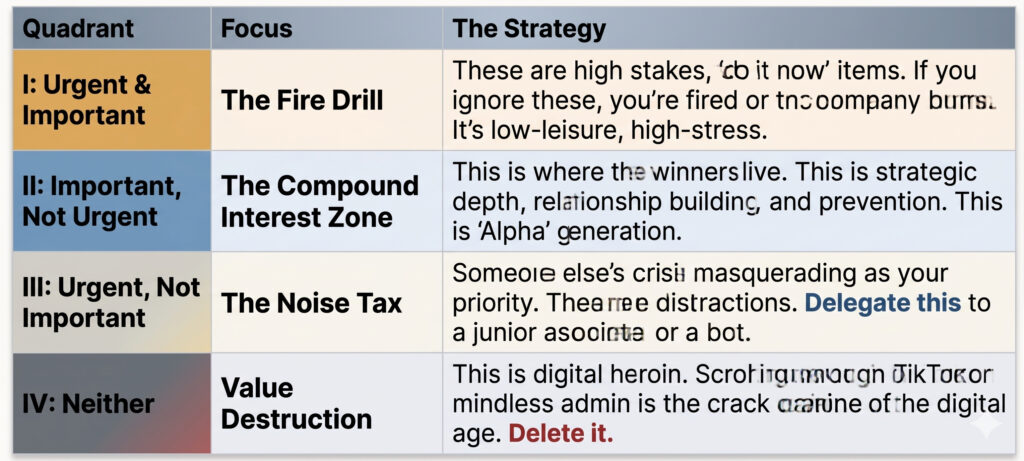
Dwight D. Eisenhower famously said, “What is important is seldom urgent, and what is urgent is seldom important.”
If you spend your life in Quadrants I, III, or IV you’re essentially paying a high-interest tax on your own potential.
To scale, you have to ruthlessly protect your time in Quadrant II. That’s where you build the “moat” around your career. Everything else is just noise.
About the Author: Jamie Turner is a CNN contributor, Emory University lecturer, and a Top 10-rated keynote speaker trusted by the world’s most iconic brands. As the author of Better: A Guidebook to a New and Improved You, Jamie specializes in the “Science of Peak Performance”—helping leaders eliminate friction and maximize impact.